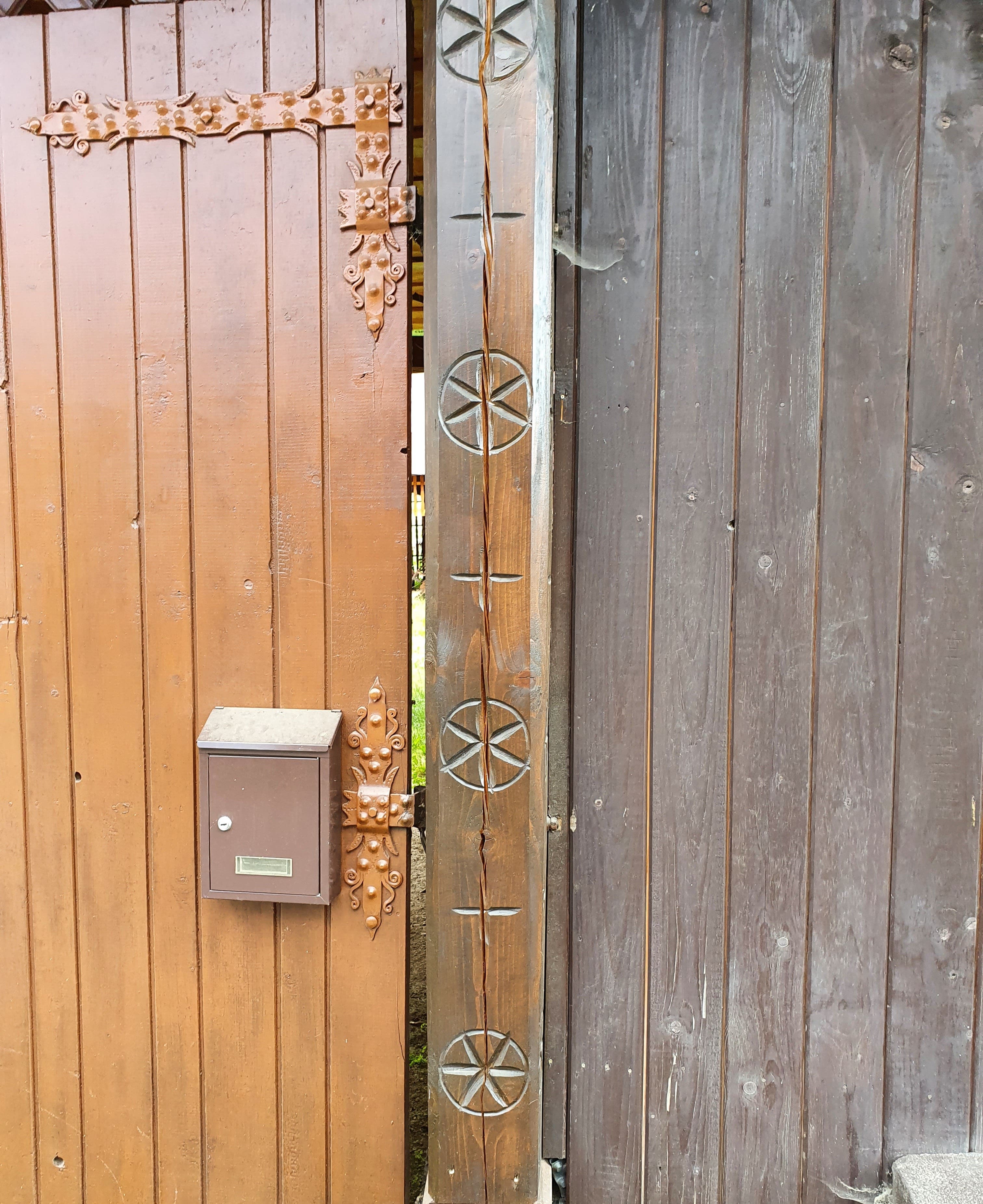
I walked past the house a half-million times and never took notice. Then, one recent afternoon, I stopped and stared at what I saw: a wooden post sharing both pre-Christian and Christian motifs. I was amused.
Visual symbols have been with us since time immemorial. Unlike emojis, the hieroglyphics of our time that convey meaning without the use of words, ancient symbols hold a special place in our subconscious to evoke a collective understanding of the world around us.
In Slavic culture are many symbols. If you read The Golden Apple, you are familiar with the sign of the Slavic god Perun, a hexagon containing three bisecting diameters. His father, Rod, the father of all things in the world, had a similar sign. His, however, was a circle with three bisecting diameters (see photo).
In around the tenth century, Vladimir the Great forewent the Slavic religion of the time to accept Christianity, expanding the Byzantine rite (also known as the Greek rite) and, in the process, strengthening the influence of Constantinople over the Slavic regions. Few relics remain of the pre-Christian religion, as Vladimir had them destroyed (mostly) and replaced by the cross.
There have been attempts to distort the history of the conversion of Slavs from pre-Christian religion to Christianity to render the story more pure and palatable to the populace. For example, although Vladimir is credited with bringing Christianity to the Slavs, the Franks had already converted the Germans in the 7th and 8th centuries and were busy converting Slavs to Christianity well before the time of Vladimir. And where some people believe Vladimir had an epiphany and saw Christianity as the one true faith, the fact is that Vladimir had an eye on the Byzantine Emperor Basil II’s sister, Anna Porphyrogenita, whose marriage to Vladimir would strengthen the Kievan Rus' political position and, thus, earning power. Finally it should be noted that, even after conversion to Christianity, Vladimir commissioned a new statue to Perun.
But there also some pretty good stories about Vladimir’s revelation. My favorite is the one by the chronicler Nestor. On the decision to select a new religion, Nestor wrote:
Of the Muslim Bulgarians of the Volga, the envoys reported there is no gladness among them, only sorrow and a great stench. He also reported that Islam was undesirable due to its taboo against alcoholic beverages and pork. Vladimir remarked on the occasion: "Drinking is the joy of all Rus'. We cannot exist without that pleasure." Ukrainian and Russian sources also describe Vladimir consulting with Jewish envoys and questioning them about their religion, but ultimately rejecting it as well, saying that their loss of Jerusalem was evidence that they had been abandoned by God.
His emissaries also visited pre-schism Latin Rite Christian and Eastern Rite Christian missionaries. […] In the churches of the Germans his emissaries saw no beauty; but at Constantinople, where the full festival ritual of the Byzantine Church was set in motion to impress them, they found their ideal: "We no longer knew whether we were in heaven or on earth", they reported, describing a majestic Divine Liturgy in Hagia Sophia, "nor such beauty, and we know not how to tell of it."
To summarize, the Jews were already abandoned by God; Muslims were sad and dirty, and whose religion would deprive Vladimir of pork and alcohol; and western Christianity was simply boring. But the show at the Hagia Sophia was an absolute hit that everyone needed to experience. Better than “Hamilton” the musical!
Ultimately Vladimir settled on Eastern Christianity. Or so the story goes.
|
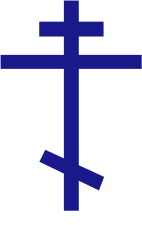
example of a Slavonic cross |
Back to symbols, the main photograph depicts both the symbol of Rod and the Christian cross being repeated on the post. Notice that the cross is a simple “+”, similar to the early Greek symbol, rather than the Eastern (or Slavonic ) cross with its three bars, the lowest of which is slanted and represents a footrest for Jesus because … his sandals were killing him?
It is my suspicion that the symbol for Rod was actually meant to be the symbol for Perun, but that a circle was easier to carve than a hexagon. But we'll never know for sure.
Doubtlessly, the symbols on the post are but decoration, the carver surely not understanding that he was intermingling both Christian and pre-Christian symbols in a repetitive style. But for those with knowledge behind the symbolism, it appears as though the carver was trying to hedge his bets. If not Christ, then perhaps Perun.
Amusement by the decorated post can only be shared by those who understand what is behind it. But now you do!