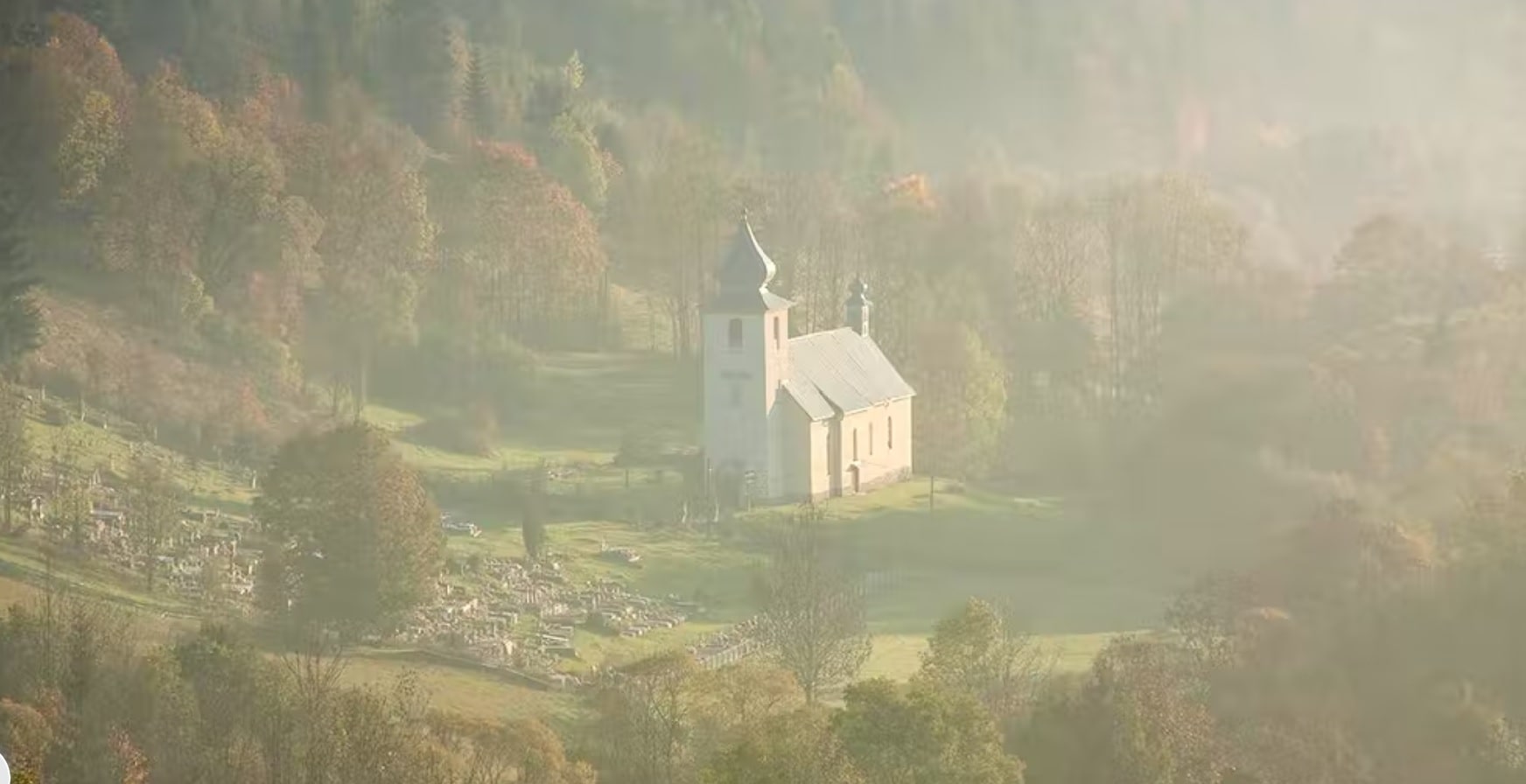
Poochini, when I moved to Osturňa over a decade ago, I fell in love with everything in the village: the villagers I encountered on the road or in the krčma, the cows lazing in the fields, the spots of white wool dotting the distant landscape in ever-changing patterns and formations, the fields of potatoes, of trava and otava. I enjoyed walking down the same meandering road as my ancestors who had walked it hundreds of years earlier, climbing the same hills my ancestors had climbed, and sharing the same view of the stars at night, infinite and floating in the vast midnight blue sky above. I remember my first summer in the house as a magical time when the ordinary transformed into the extraordinary, the mundane into wildly fascinating. In the evenings alone in my candlelit room, ancestors sometimes made silent visits, evidenced by shadows that flickered fleetingly on the walls and ceiling.
It is true that life had previously taken me to many places, wonderful places like New York, a city simultaneously fantastic and terrifying, at times full of exquisite beauty and inspiration, and at others, cruel and hideous, but always filled with enormous possibilities for those smart enough, talented enough, and fast enough to exploit them; to our nation’s capital with its stunning monuments to the builders and upholders of democratic principles, monuments that brightly and proudly shine at dusk as an apt reminder that the light on democracy can just as quickly be extinguished if one does not remain vigilant; to the place originally given the name “Terminus” that, but for the invention of the automobile, might have grown to become a reasonable place to live; to Baltimore, which is not so much a city as it is a dense collection of quirky little towns and villages, each with its own defining character and points of distinction; and finally to Kraków, a city of exquisite ancient architecture spanning multiple styles that reflects the storied history of this once capital city which, along with its old Polish charm, renders this city as beautiful as it is soporific. But none has pleased me more than this speck of a village called Osturňa.
Once settled into Muržin, I knew I would never leave. This was to be my home forever. In Osturňa I found a home, a real home, not like the one in which I was raised on Goddard Road, an example of that grotesque experiment in American post-WWII suburban housing that provided no more real comfort or amenities than the five-story high-rise developments in post-WWII Soviet Union, but a real home, one with already deeply established roots where I could ground myself; one with history, with family nearby and neighbors I knew, one without an indoor toilet or shower…
Poochini, you do not remember my friend, Martin, whose lamp went dark before you were born. We fast became best friends almost as soon as I arrived, and we shared all sorts of experiences together. Although raised his entire life in Osturňa, Martin had never been to the Tatra Mountains. So, what a treat it was one day when I took him by cable car to Lomnický štít. I had to loan him my sweater that afternoon, as his short-sleeved cotton shirt was no match for the sudden fluctuations in temperature we experienced each time a cloud suddenly rolled in over the peak and then just as quickly rolled out a few minutes later. We later dined that day at Grand Hotel Kempinski in Štrbské Pleso where the food was as delicious as it was expensive.
It was an unspoken certainty that Martin and I could depend upon each other at any time of day and for any reason. Had his final alcoholic binge, commencing after the sudden and successive deaths of both parents, not masked the tumors in his brain that distorted his thoughts, perhaps – I say “perhaps” because I do not know – the doctors could have found the tumors earlier while still operable. The hole his absence left in my heart has yet to fully heal.
As Martin was younger than me, I told him of my final wishes that should be carried out following my demise. I did not want my body dumped in the village cemetery to be used as an unwilling participant in an underground smorgasbord where I would be the main course. I had loftier ideas in mind. Martin knew that on the mountain between Osturňa and Ždiar was the highest peak at 1,254 meters above sea level, one with a name I do not know. It was from that vantage point, overlooking the villages below and the mountains beyond, that I wanted my ashes sprinkled. I thought it a perfect metaphor for my life: watching without participation, adjacent to but not within, close yet remote.
But I have changed my mind, Poochini. No longer do I wish for my ashes to be sprinkled on the distant mountain overlooking the village. It is already so long ago since I felt myself a foreigner in a strange new land, baffled by a new reality. I have since made a home here. I feel part of the community in which I live. I have celebrated the births of new villagers and mourned the deaths of friends and family. In short, I have become a part of Osturňa.
Should my demise arrive sooner than yours, Poochini, I give to you the responsibility to ensure my wishes are carried out to their fullest. I ask that my ashes be placed in the ground on my property u Muržína. And be sure to save a little to sprinkle around Schodný Vody as a tribute to the beauty and tranquility it offered me over the years. I shall then be at peace. Mourn for me if you must, but not too deeply nor too long.
And you, Poochini, you shall be fine. Perhaps you will go to live with your best dog friend, Brok, and visit Schodný Vody on occasion to cool yourself in the waters and the shaded air under the weeping willow that we so often shared. And perhaps you will think of me now and then and our lovely times together. I would like that.